Global Economics 6.9.25
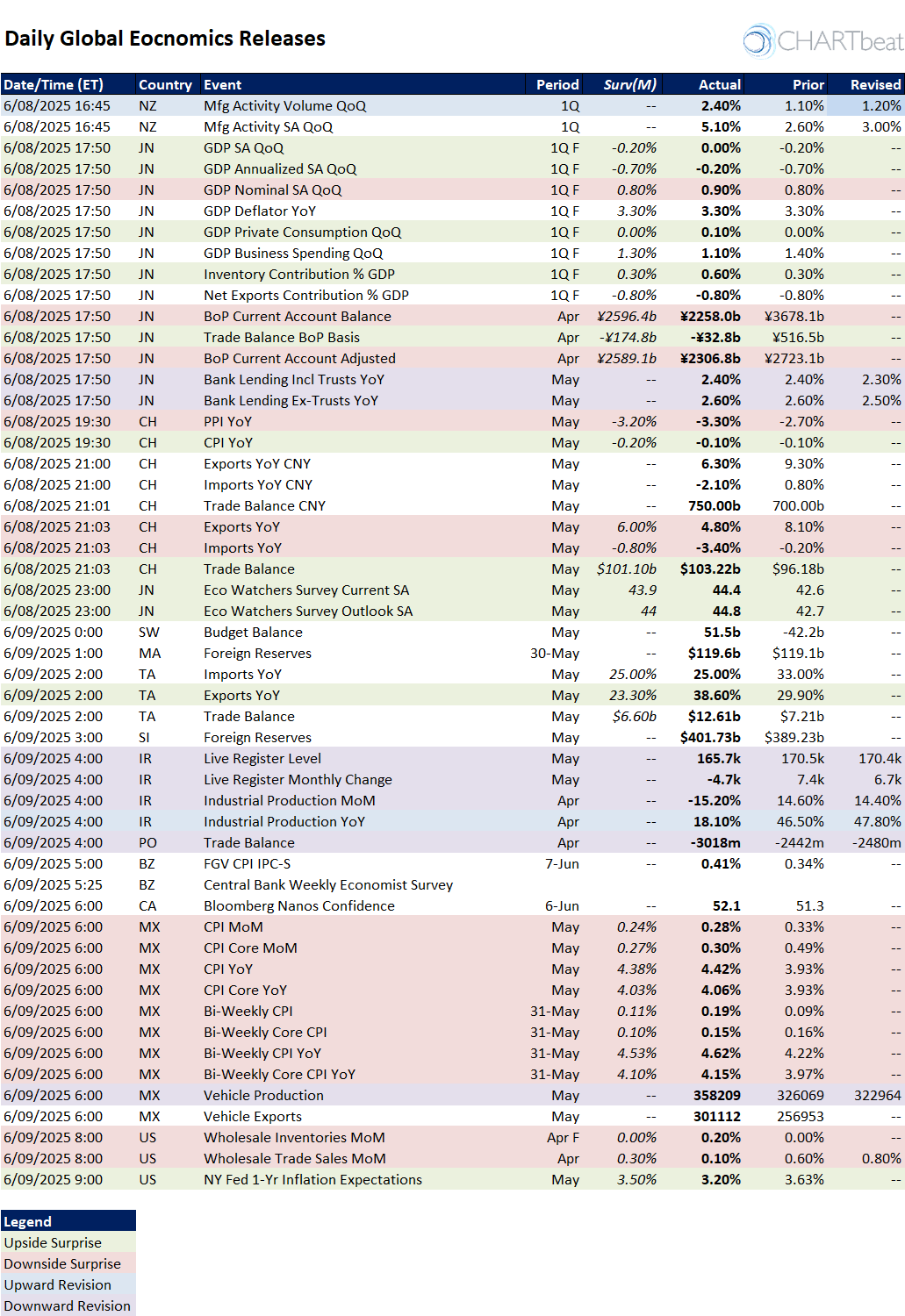
Economic data through June 9, 2025, underscores a global economy in transition—some regions show tentative resilience while others reveal clear signs of cooling, especially in trade and inflation dynamics.
Japan offered a slight upside surprise in its final Q1 GDP readings. Real GDP (SA QoQ) came in at 0.0%, beating the expected -0.2% and matching the prior estimate, indicating flat but stabilizing output. The annualized figure improved to -0.2% from an expected -0.7%, suggesting that Japan narrowly avoided contraction. Business spending remained solid (+1.1%), though private consumption (0.1%) was soft, and net exports continued to be a drag. The external position weakened materially—April’s current account balance (¥2258.0b) missed expectations of ¥2596.4b and was sharply lower than March’s ¥3678.1b. Similarly, the BoP trade balance swung from a prior surplus to a small deficit, further emphasizing the pressure from weaker exports and global demand.
In China, the latest data pointed to persistent deflationary forces. May CPI was -0.1% year-over-year—slightly better than the -0.2% consensus but unchanged from the prior month. Meanwhile, producer prices fell more sharply than expected at -3.3%, widening the gap from April’s -2.7%. Trade activity also softened: exports slowed to 4.8% (vs. 6.0% expected, and 8.1% prior), while imports contracted 3.4%, a significant miss relative to forecasts and a worsening from April’s -0.2%. Despite a higher trade surplus in yuan and USD terms, the underlying story was one of sluggish demand both domestically and abroad.
Taiwan was a bright spot, with exports surging 38.6% in May—well above the 23.3% expectation and an acceleration from the prior 29.9%. The trade balance also far exceeded expectations, at $12.61 billion versus the expected $6.60 billion. However, flat import growth (25.0%) may suggest demand remains export-led rather than balanced by domestic consumption.
Mexico showed signs of a still-hot inflation environment, though gradually easing. Headline CPI rose 4.42% in May, slightly above the 4.38% consensus and up from 3.93% in April. Core inflation followed suit, with both monthly and annual readings marginally exceeding expectations. However, the broader economy showed strength: vehicle production rose to 358,209 units from a revised 322,964, and exports increased sharply as well—evidence of sustained industrial activity and external competitiveness.
In the United States, April wholesale inventories were flat (0.0%), in line with expectations and unchanged from the revised prior reading. Wholesale trade sales grew 0.6%, doubling the forecasted 0.3% increase, though this represented a slowdown from the prior 0.8%. Most notably, NY Fed 1-Year Inflation Expectations came in at 3.20%, below the 3.50% consensus and also down from April’s revised 3.63%. This marks a moderation in short-term inflation sentiment, potentially easing some of the pressure on the Federal Reserve to maintain a hawkish stance.